
Best eSIM for Europe: Local vs Regional Plans Explained
A Europe eSIM planning guide that explains when to buy one regional plan, when to buy local country plans, and how to compare coverage, data, validity, and price.

Quick answer
For a single-country trip start with a local plan; for a route that crosses several borders, a regional Europe plan is usually easier. The best eSIM for Europe depends on your itinerary: a regional plan keeps one data line active across borders, while a local plan can be cheaper or cleaner when one country dominates the trip. Before buying, check the exact country list, match validity to the full trip, and compare price per GB — Europe plan coverage differs by provider.

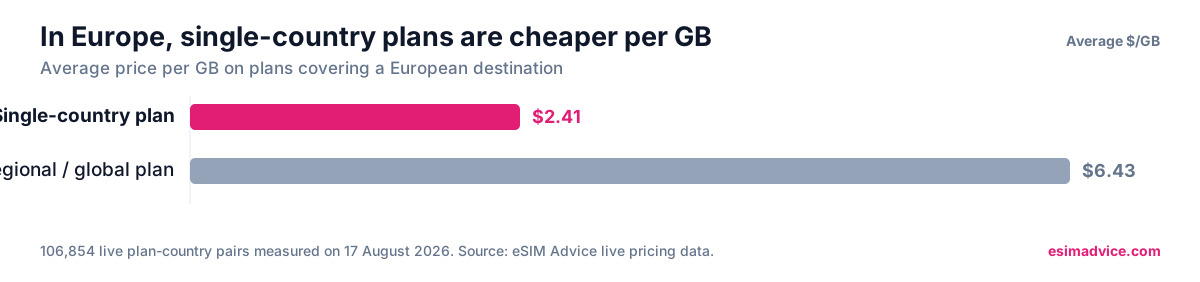
Europe eSIM planning is not one-size-fits-all
The best eSIM for Europe depends on your itinerary. A traveler spending one week in France has a different need from someone visiting France, Italy, Switzerland, and the United Kingdom in one trip.
The main decision is simple: buy one regional Europe plan or buy separate local plans for each country. The better option depends on country coverage, data size, validity, price per GB, hotspot, and how often you cross borders.
Start with the Europe regional page and the ranked best eSIMs for Europe, then compare important country pages such as France, Italy, Spain, Germany, and United Kingdom.
Choose a regional Europe eSIM when you cross borders
A regional plan is usually easier when your trip covers multiple countries. You install one eSIM, keep one data line active, and avoid buying a new plan every few days.
Regional plans are especially useful for train trips, business travel, backpacking routes, and itineraries with short stops. They also reduce the risk of landing in a second country with no data because you forgot to buy another plan. For complex routes, the multi-country search shows plans that cover every stop in one purchase.
Before buying, check the exact country list. Europe plan coverage can differ by provider. Switzerland, Turkey, Iceland, Serbia, or smaller territories may be included by one provider and excluded by another.
Choose local plans when one country dominates the trip
If most of the trip is in one country, a local plan can be cheaper or cleaner. Local plans may offer better price per GB, more plan sizes, or clearer destination-specific coverage.
For example, a two-week France trip should start with France eSIM plans. A Japan-only or Thailand-only trip should not be forced into a global bundle unless there is a specific reason.
Local plans can also be easier to compare because the destination is clear. You can filter by data amount, validity, 5G, hotspot, and deal availability.
Watch validity and data size
Match validity to the full trip
Europe trips often run longer than city breaks. A cheap seven-day plan may look good until your itinerary is ten or fourteen days. Compare the full trip length, not just the headline price.
Estimate data before you choose
If you use maps, messaging, and restaurant apps, 5GB to 10GB may be enough for a short trip. If you use social video, upload photos, take video calls, or use hotspot, compare 20GB or more. Use the data calculator before choosing.

Check provider strengths
No provider wins every country. A provider that is cheap in France may not be the best for Spain or Italy. Compare provider profiles such as Saily, Nomad, MobiMatter, SimLocal, and Yesim in the provider directory, then return to the country page for final sorting.
Europe buying checklist
- List every country in the itinerary.
- Decide whether one regional plan covers all stops.
- Compare price per GB and total price.
- Match validity to the full trip.
- Check hotspot if you will use a laptop.
- Check 5G labels if speed matters.
- Confirm activation timing before installing.
- Confirm the final coupon price at checkout, using the eSIM coupon codes page for current codes.
Bottom line
For one country, start local. For several countries, start regional. For complex routes, compare both. The best Europe eSIM is the one that covers every stop, lasts the full trip, and gives enough data without forcing you into a second purchase halfway through.
FAQ
Is a regional Europe eSIM better than local plans?
It is usually easier when your trip crosses several borders: one eSIM, one active data line, and no new purchase every few days. For a trip dominated by one country, a local plan can be cheaper or cleaner.
Do all Europe eSIM plans cover the same countries?
No — Europe plan coverage can differ by provider. Switzerland, Turkey, Iceland, Serbia, or smaller territories may be included by one provider and excluded by another, so always check the exact country list.
How much data do I need for a Europe trip?
For maps, messaging, and restaurant apps, 5GB to 10GB may be enough for a short trip. For social video, photo uploads, video calls, or hotspot use, compare plans with 20GB or more.
When is a local eSIM the better choice?
When most of the trip is in one country. Local plans may offer better price per GB, more plan sizes, and clearer destination-specific coverage, and they are easier to compare because the destination is clear.
What should I check before buying a Europe eSIM?
List every country in the itinerary, match validity to the full trip length, compare price per GB and total price, and check hotspot, 5G, and activation timing. Then confirm the final coupon price at checkout.