
How Much eSIM Data Do You Need for Travel?
The right eSIM size depends on trip length and the apps you use every day. Light travelers who mostly use maps, messaging, and email can often start with…

Quick answer
The right eSIM size depends on trip length and the apps you use every day. Light travelers who mostly use maps, messaging, and email can often start with 3GB to 5GB for a week. Travelers using social apps, video calls, uploads, or remote-work tools should compare 10GB, 20GB, or unlimited options. The fastest way to get a personal answer is the eSIMAdvice data calculator — it turns your actual habits into a plan size and adds a 20% buffer so you are not forced to buy a second plan halfway through the trip.
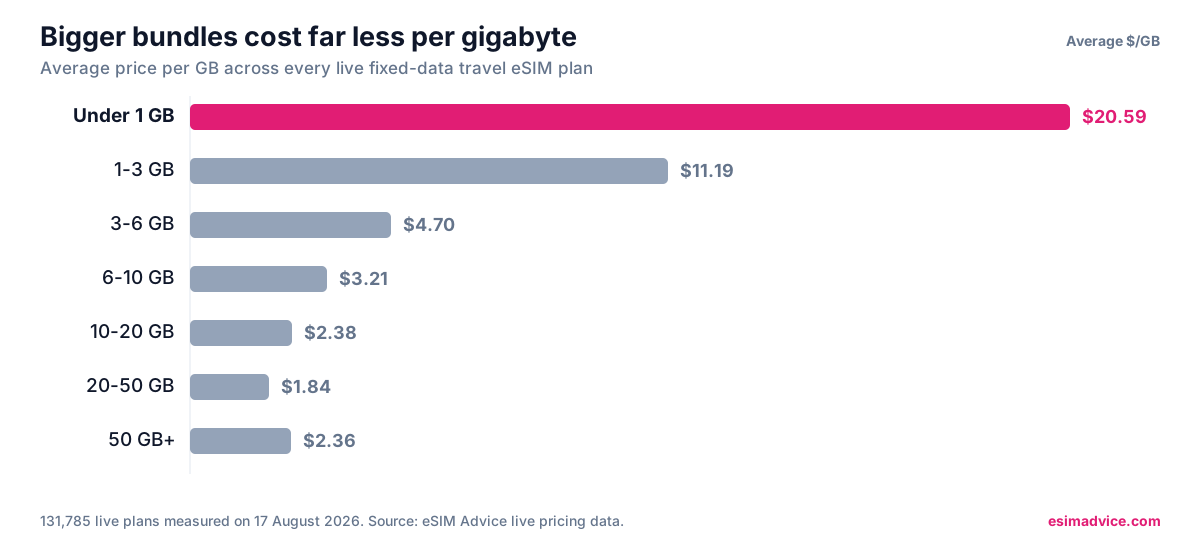
If you only remember one rule, make it this: it is almost always cheaper to buy slightly too much data upfront than to buy a second plan in a panic on day five. Running out mid-trip means paying again, often at a worse per-gigabyte rate, exactly when you need connectivity most.

What actually uses your data
Most people have no idea which apps drain a data plan, because at home an unlimited contract hides the cost. Abroad, on a fixed bucket, the differences become very real. The figures below are rough, deliberately conservative estimates — real usage varies with app settings, video quality, and signal conditions — but they are close enough to size a plan sensibly.
| Activity | Rough data use | Travel verdict |
|---|---|---|
| Messaging (text only) | A few MB per day | Negligible |
| Email without big attachments | A few MB per day | Negligible |
| Maps and navigation | Around 5–10MB per hour | Very light |
| Web browsing and search | Roughly 50–100MB per hour | Light |
| Music streaming | Roughly 50–150MB per hour | Light to moderate |
| Social feeds with video (Reels, TikTok, Shorts) | Roughly 150–500MB per hour | Heavy |
| Video calls | Roughly 500MB–1GB per hour | Heavy |
| Video streaming in HD | Roughly 1–3GB per hour | Very heavy |
| Cloud photo/video backup | Depends entirely on what you shoot | Potentially very heavy |
Two patterns matter here. First, maps and messaging use very little data — the things you genuinely need while traveling are cheap. Second, short-form video and video calls increase usage quickly — a single hour of scrolling Reels can burn more data than a full day of navigation, messaging, and browsing combined.
The silent data eaters
The activities in the table are ones you choose. The bigger surprises are the ones running without you noticing. Automatic cloud backup is the classic trip-killer: shoot an afternoon of holiday video, and your phone may try to upload gigabytes over cellular that evening. App and system updates, email attachment auto-download, and autoplay video in social and news apps all quietly add up too.
Before you fly, set photo backup to Wi-Fi only, restrict app updates to Wi-Fi, and turn off autoplay where the app allows it. Those three settings changes can cut a heavy user's consumption dramatically without changing how the trip feels.
Daily profiles: which traveler are you?
Rather than adding up megabytes, it is easier to match yourself to a profile. These are broad buckets, not precise measurements, but they map well onto how plans are actually sold.
| Profile | Typical habits | Rough daily use | Rough weekly need |
|---|---|---|---|
| Light | Maps, messaging, email, some browsing | Around 300–500MB | 3–5GB |
| Moderate | All of the above plus social apps, music, photo sharing | Around 1–2GB | 7–15GB |
| Heavy | Frequent video, video calls, hotspot for a laptop | Around 2–5GB | 15GB to unlimited |
| Remote worker | Video meetings, cloud tools, laptop tethering all day | Often 3GB+ | Unlimited or large fixed plans |
A useful sanity check: your phone already knows your real number. On iPhone, Settings, then Cellular (or Mobile Data), shows per-app usage since the last reset. On Android, Settings, then Network & internet, then your SIM's data usage, shows a monthly breakdown. Divide your normal monthly total by 30 for a personal daily baseline, then adjust for travel — most people navigate and upload more abroad, but stream less.
If that arithmetic sounds tedious, that is exactly what the data calculator automates. You tell it how you use your phone and how long you are away, and it does the sizing and the buffer for you.
How much data by trip length
Trip length changes the math more than any other factor, because buying one right-sized plan almost always beats stacking small ones. Here is how the profiles above translate into common trip shapes.
| Trip length | Light user | Moderate user | Heavy user |
|---|---|---|---|
| Weekend (2–4 days) | 1–3GB | 3–5GB | 5–10GB |
| One week | 3–5GB | 7–15GB | 15GB+ or unlimited |
| Two weeks | 5–10GB | 15–20GB | 20GB+ or unlimited |
| One month | 10–20GB | 20–30GB | Unlimited |
For short breaks, the smallest plans are tempting, but the savings are usually tiny — compare the options in our weekend trip picks and you will often find a few extra gigabytes cost very little. For longer trips, look at two-week plans and month-long plans specifically, because plan validity matters as much as plan size — a big data bucket is useless if it expires on day 15 of a 30-day trip.
Multi-country itineraries add one more wrinkle: you need the plan to work everywhere you go, not just the first stop. A regional or multi-country plan sized for the whole route usually beats buying per-country, and you can search plans that cover your exact country combination instead of guessing. For complex routes, the trip stacker helps you compare one big plan against a chain of smaller ones.
How to estimate your own number in five minutes
If you want to do this properly rather than guess, the process is short:
1. Check your real monthly usage in your phone's settings, as described above, and turn it into a daily average. 2. Adjust for travel behavior. Add for navigation, translation apps, ride-hailing, and photo uploads; subtract for time you will spend on hotel Wi-Fi. 3. Multiply by trip days, using the number of days you will actually rely on cellular data. 4. Add a buffer of around 20%. Plans that end early cost more to rescue than buffers cost to buy. 5. Round up to the nearest plan size that exists in the market — plans come in steps, so you are choosing between real options, not abstract numbers.
The data calculator runs this exact logic for you, including the 20% buffer, and then shows real plans at that size for your destination. Whichever route you take, do the estimate before you compare prices — a cheap plan at the wrong size is not cheap.
One more sizing note: browse plans for your destination on our country pages once you have a number in mind. Per-gigabyte pricing varies a lot by country, and the price index shows where data is cheap and where it is genuinely expensive — in pricey destinations, trimming your usage matters more.

How to make your data last longer
Whatever size you buy, a few habits stretch it further. None of these require sacrifice; they mostly eliminate waste.
- Download offline maps before you leave. Offline navigation reduces map data use to almost nothing, and it keeps working in dead zones.
- Set photo and video backup to Wi-Fi only. This is the single highest-impact setting for most travelers.
- Turn off autoplay in social, video, and news apps, and prefer lower video quality when you do stream on cellular.
- Restrict background app refresh for apps you do not need updating constantly — most phones have a low-data or data-saver mode that does this in one switch.
- Download entertainment in advance. Playlists, podcasts, and shows downloaded over Wi-Fi cost nothing in the air or on the train.
- Use Wi-Fi for the heavy lifting. Save video calls home and large uploads for the hotel connection where you can.
These habits pair naturally with avoiding accidental roaming on your home SIM — if you are running a dual-SIM setup with your home number active for calls, make sure data is pinned to the travel eSIM. Our guide to avoiding roaming charges covers that configuration in detail, including the dual-SIM settings screen by screen.
Hotspot, remote work, and the unlimited question
Two groups consistently under-buy: people tethering a laptop, and people who assume "unlimited" means unlimited.
Hotspot use changes everything. A laptop consumes data far faster than a phone — desktop websites, sync clients, and background updates are all heavier than their mobile versions. If you plan to tether for work, treat yourself as a heavy user at minimum and compare plans that explicitly allow tethering, because not every plan permits hotspot use. Our roundup of the best hotspot eSIMs filters for plans where tethering is allowed, and remote workers should also look at plans suited to digital nomads, where large buckets and long validity matter most. Remote workers should compare hotspot rules before buying — it is the one plan term that can sink a workation on day one. If you are weighing an eSIM against carrying a separate hotspot device, our eSIM vs pocket Wi-Fi comparison covers that trade-off.
Unlimited plans can still have fair-use limits or speed caps. Many "unlimited" travel plans deliver full speed for a set amount per day and then throttle, or reserve the right to slow heavy users. That can still be a great deal — throttled data is fine for maps and messages — but you should know the rules before you rely on one for video calls. We break down how these policies actually work in the truth about unlimited eSIM data, and our unlimited plan comparison flags the fair-use terms we could find. Always confirm the final provider terms at checkout.
What to do if you are about to run out
Even good estimates sometimes lose to reality. If your plan's balance is draining faster than planned, act early rather than at zero.
First, check your remaining balance in the provider's app and work out your real daily burn rate. Second, apply the savings habits above immediately — Wi-Fi-only backup and no autoplay buy you days, not hours. Third, top up before you hit zero if your provider supports it; topping up an active plan is usually smoother than activating a brand-new one, and it avoids any gap in service.
If your provider's top-up pricing is poor, buying a second plan from a different provider is completely legitimate — your phone can hold multiple eSIM profiles, and switching between them takes seconds. Compare current per-gigabyte pricing for your destination before you pay, rather than defaulting to whoever sold you the first plan. And for next time, feed what you learned back into the data calculator — one trip of real usage data makes every future estimate accurate.
FAQ
How much data do I need for one week of travel?
For most people, somewhere between 3GB and 15GB. Light users who stick to maps, messaging, and email can often manage on 3–5GB, moderate users with social apps and music typically want 7–15GB, and heavy video users or laptop-tetherers should look at 20GB or unlimited. The data calculator narrows that range to a personal number in about a minute.
Is 1GB per day enough for travel?
For a moderate user, usually yes — 1GB per day covers navigation, messaging, browsing, music, and reasonable social use with room to spare. It gets tight if you watch a lot of short-form video, make long video calls, or upload lots of photos and video over cellular. If any of those describe you, budget closer to 2GB per day or consider an unlimited plan.
How much data do Google Maps and navigation use?
Very little — roughly 5–10MB per hour of active navigation, and close to zero if you download offline maps in advance. Navigation is one of the cheapest things you can do with a travel data plan, so never ration it. The expensive activities are video, video calls, and uploads.
Does hotspot or tethering use more data?
Tethering itself does not multiply data, but the laptop on the other end almost always uses far more than a phone would — desktop sites, sync services, and OS updates are heavier. Plan for at least 2–3GB per working day if you tether regularly, and check that your plan allows hotspot use at all before buying.
Should I just buy an unlimited plan to be safe?
If you are a heavy user, a remote worker, or simply hate tracking a balance, unlimited is a reasonable convenience — but read the fair-use terms first, because many unlimited plans throttle speeds after a daily full-speed allowance. For light and moderate users, a right-sized fixed plan is usually cheaper — the section on unlimited plans above covers how the fine print works.
What happens if my eSIM data runs out mid-trip?
Nothing dramatic — data simply stops (or slows, on throttled plans) until you top up or buy another plan. The practical costs are inconvenience and price: last-minute purchases are rarely the best deal. Watch your balance in the provider's app, top up before zero, and remember you can always add a second eSIM from a different provider if the top-up pricing is bad.
How do I check how much data I normally use?
On iPhone: Settings, then Cellular, scroll to the per-app usage list. On Android: Settings, then Network & internet, then your SIM, then data usage. Take your normal monthly total, divide by 30 for a daily average, and use that as the starting point for your travel estimate — then add a 20% buffer for the extra navigation and uploads travel brings.